Order tracking
What is order tracking?
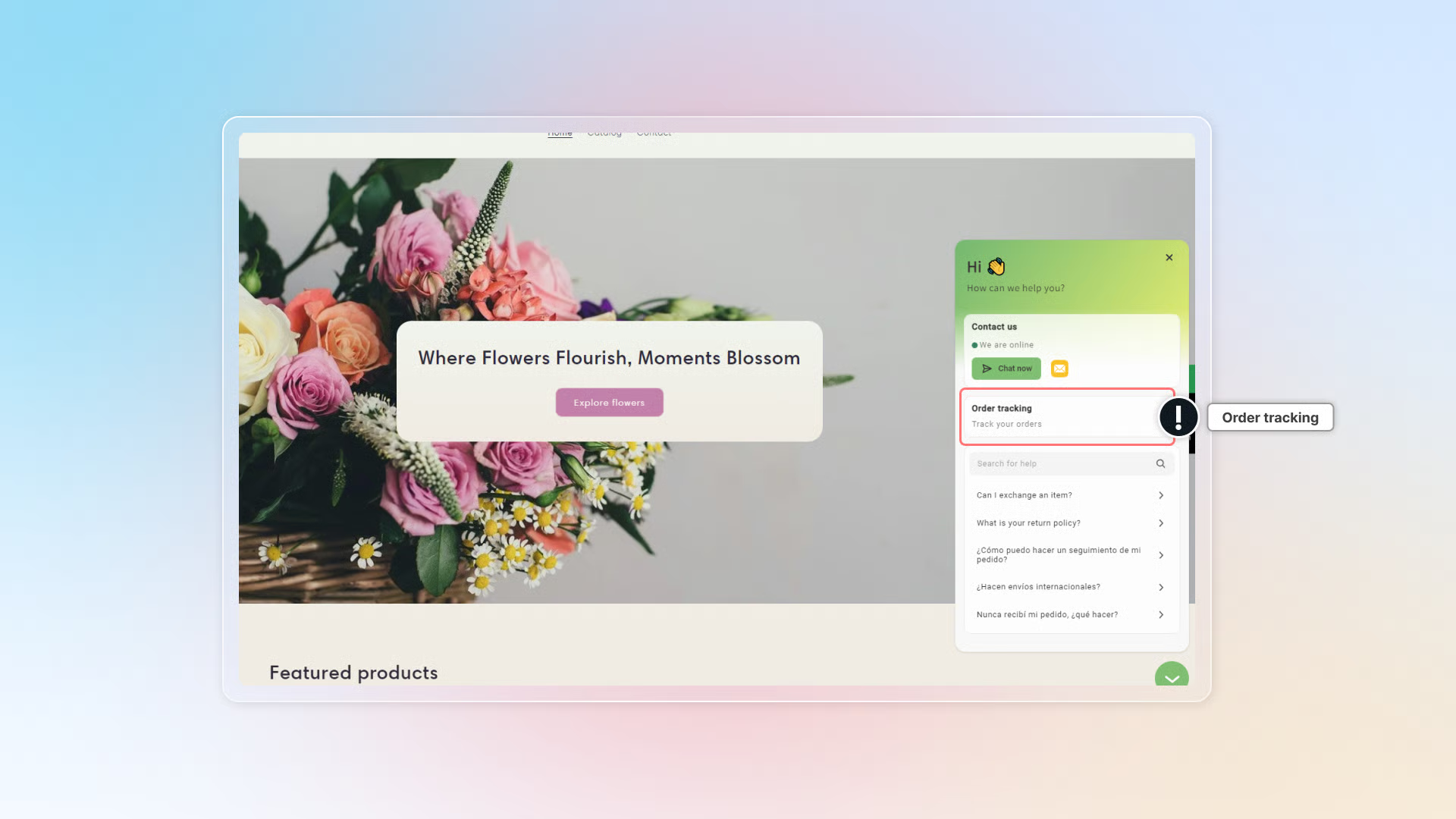
Order tracking is a self-service feature that lets customers check their order status and shipment progress directly through your chatbox.
Customers can look up an order with an order number or a tracking number.
How to set up order tracking
Enable order tracking in your chatbox
-
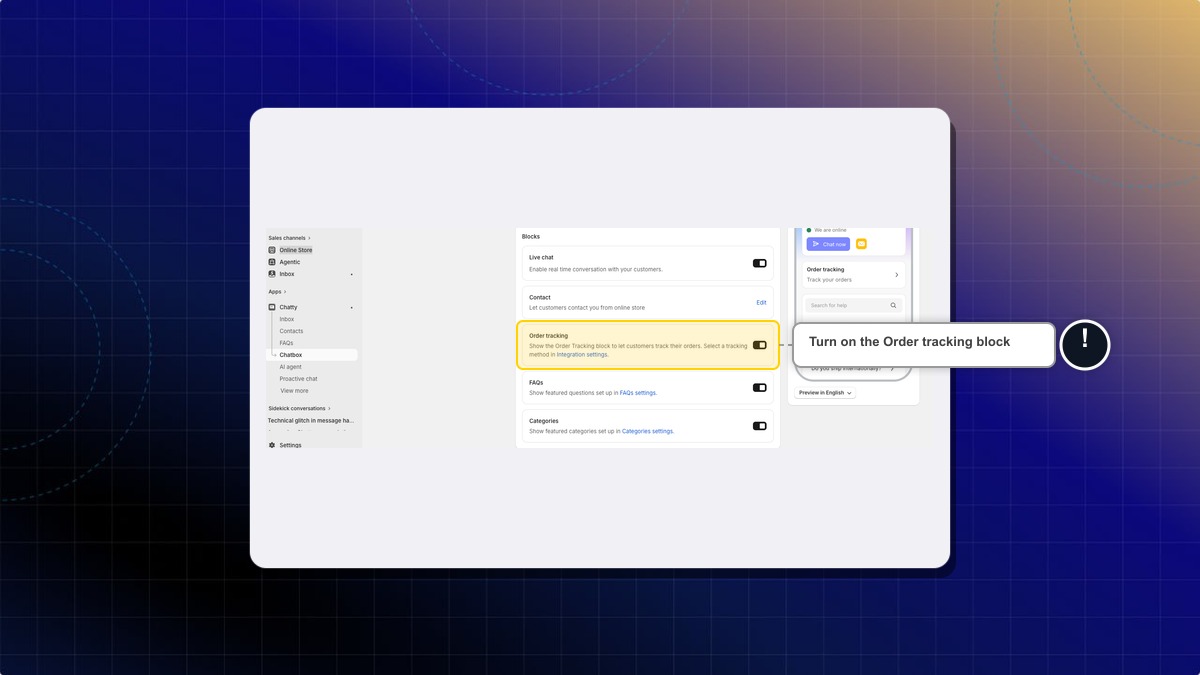
Go to Chatbox.
-
On the General tab, scroll to Blocks and turn on Order tracking.
-
Click Integration settings on that block to pick your tracking method.
Choose your tracking method
-
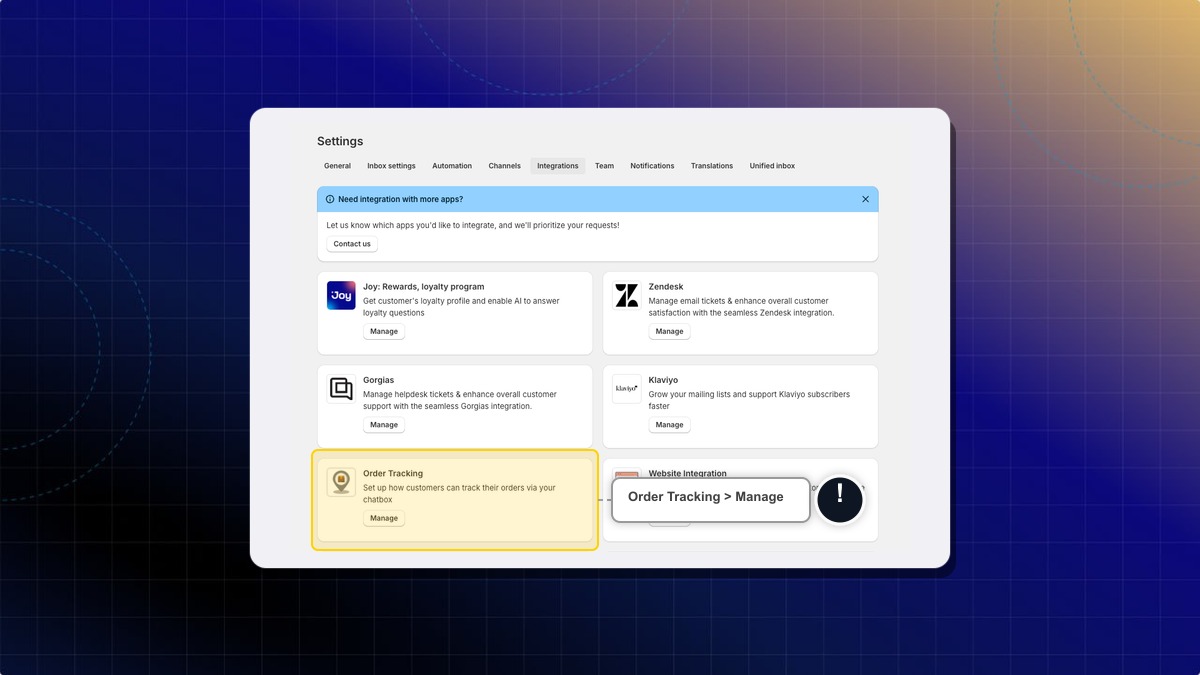
Go to Settings → Integrations.
-
In Order Tracking, click Manage.
-
Select your preferred tracking method.
Click Save
Expected result: The order tracking block appears in your chatbox, using the method you picked.
Compare tracking methods
| Tracking method | Best for | How it works |
|---|---|---|
| Default tracking | Stores using major carriers such as DHL, FedEx or UPS | Sends customers to the carrier's own tracking page |
| Custom tracking | Stores using local carriers or a private shipping service | Sends customers to a tracking link you write, for orders with no carrier link |
| Integrate with tracking app | Stores that want customers to stay on site | Shows shipment status inside the chatbox |
How to add input fields to your custom tracking link
Some carriers need more than a tracking number to open the right page, such as an order number or a postcode. You can add placeholders to your custom tracking link. Each one becomes a field the customer fills in before tracking.
You can use five placeholders: {tracking_number}, {order_number}, {zip_code}, {email} and {phone}.
Each one can appear once. The Insert button turns off after you use its placeholder.
- Open the Order Tracking panel, as in the setup steps above.
- Select Custom tracking.
- Type your tracking link. It must start with
https://. - Click an Insert button to add a placeholder. It lands at the end of the link, so type the placeholder yourself if the carrier needs it elsewhere. Example:
https://track.example.com/{order_number}/{zip_code}. - Under Fields customers will fill in, set a label for each placeholder. Leave one empty to use its default.
- Check the Opens line under the preview. It shows the finished link with sample values.
- Click Save.
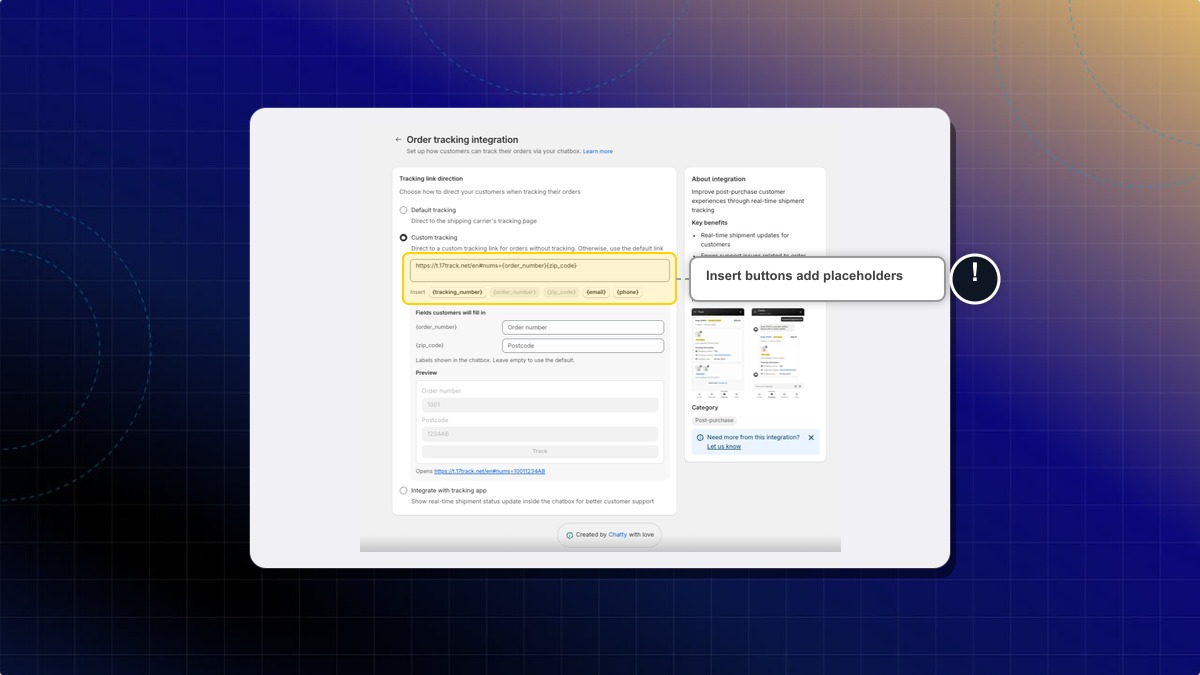
Expected result: The tracking tab shows one input field for each placeholder. When the customer fills them in and clicks Track, Chatty opens the finished link.
Default labels are Tracking number, Order number, Postcode, Email address and Phone number. The {phone} field adds a country code picker. Chatty URL-encodes whatever the customer types.
If you use any placeholder other than {tracking_number}, the Order number and Tracking number tabs disappear. Customers see a single form instead.
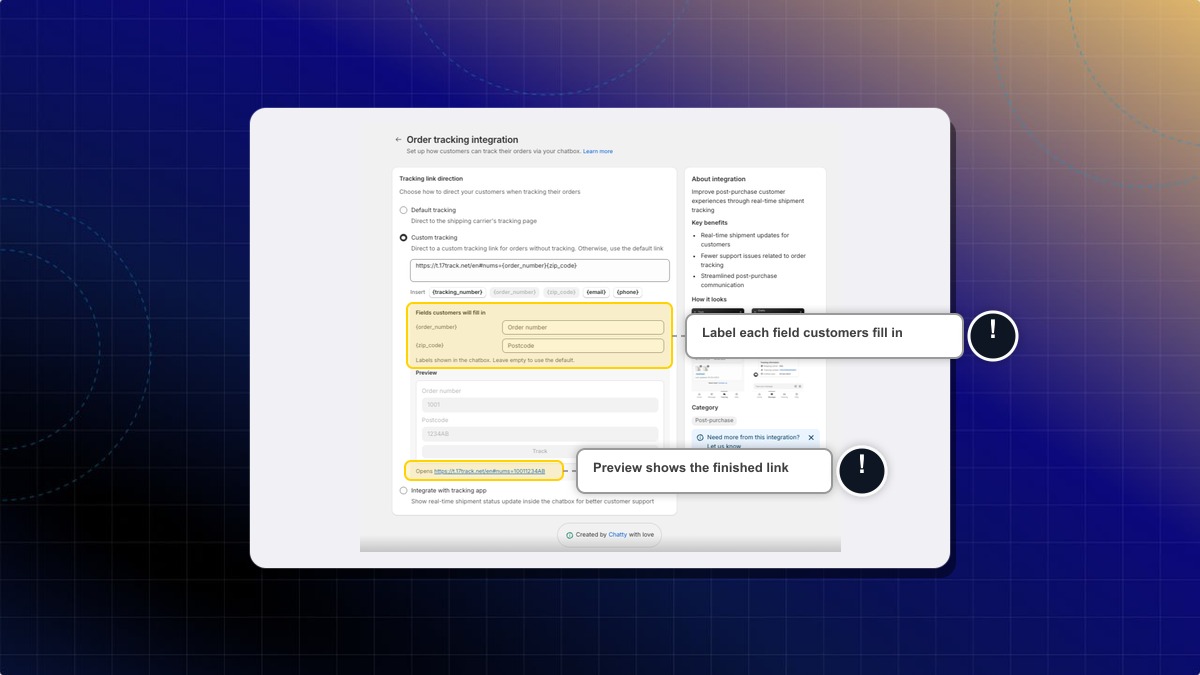
A tracking link with no placeholder opens directly for the customer, and the tracking tab shows no input fields. If that link ends in =, ?, & or /, Chatty adds the tracking number to the end.
Save fails if the link does not start with https://, or if it holds a placeholder Chatty does not know. The error names the unknown placeholder.
How to connect a tracking app
- Open the Order Tracking panel, as in the setup steps above.
- Select Integrate with tracking app.
- Under Step 1. Select tracking provider, tick 17Track.
- Under Step 2. Set up integrations, paste your API key.
- Click Connect.
- Click Save.
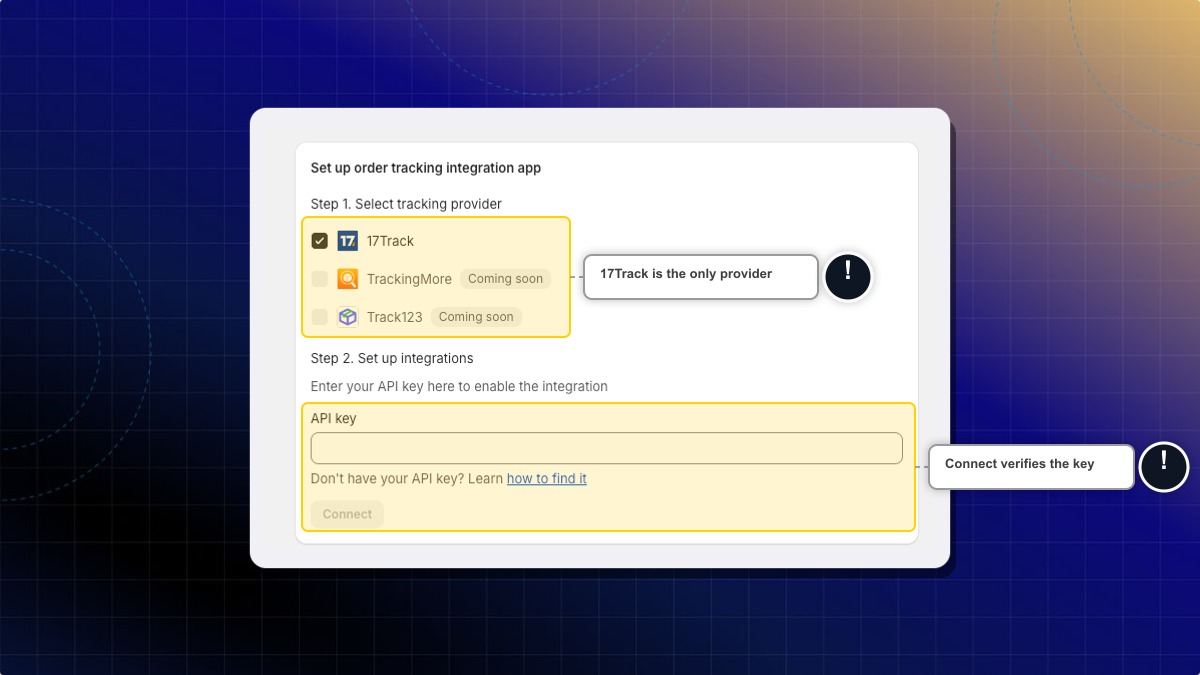
Expected result: Shipment status appears inside the chatbox. Customers never leave your store.
Connect stays greyed out until you enter a key. Save is then refused until Connect verifies it, and Chatty asks you to click Connect first.
17Track is the only provider you can pick today. TrackingMore and Track123 show a Coming soon badge and cannot be selected. Use the how to find it link beside the field if you do not have an API key yet.
How customers track an order
On your website
- Open the chatbox.
- Click Order tracking.
- Enter an order number or a tracking number.
- Click Track.
- With an order number, add an email or phone number.
- With a tracking number, add the tracking number.
Expected result: The chatbox shows the shipment status for that order.
In conversation with AI
- Ask about your order in the chatbox.
- Give the AI the order number, tracking number, email or phone number it asks for.
Expected result: The AI replies with the current shipment status.
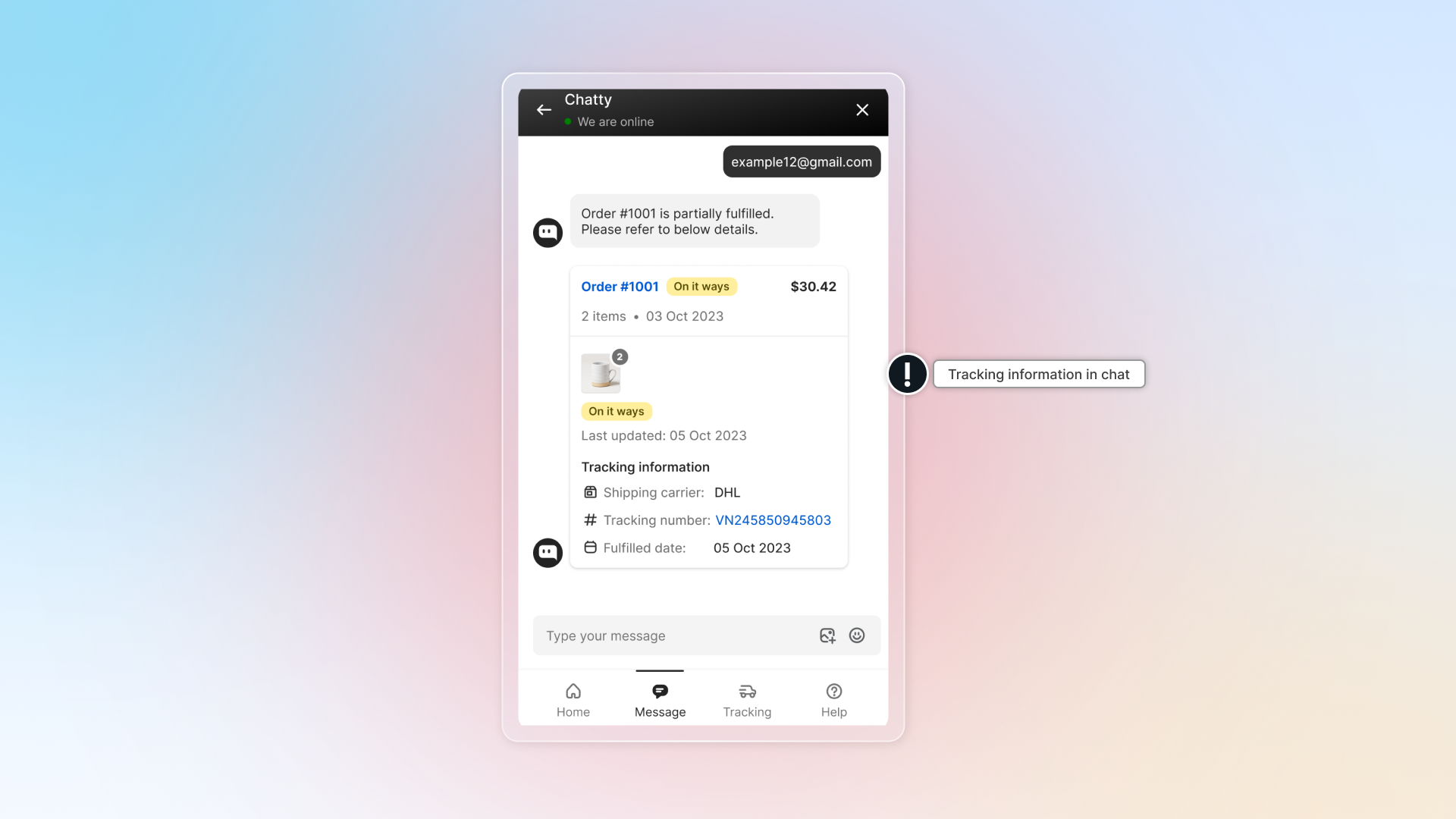
What customers see in tracking information
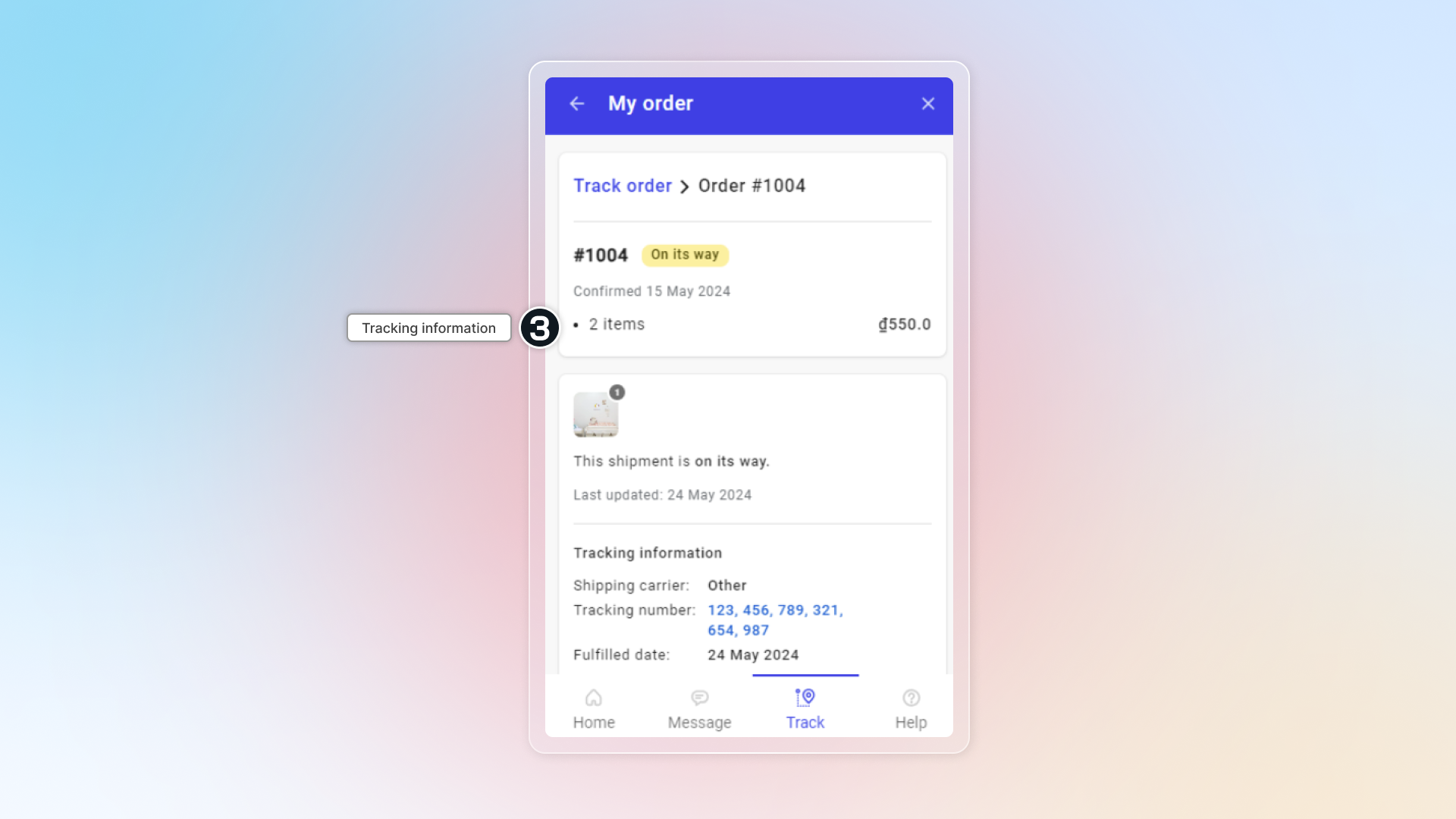
General order information
- Order number
- Order status (varies by product type)
- Digital orders: Confirmed or Completed
- Physical orders: Confirmed, On its way, or Delivered
- Confirmation date
- Total items
- Total amount
Tracking information
- Product images and quantities
- Shipment status and update date
- For shipped orders: Confirmed → On its way/Attempted delivery → Delivered
- For digital orders: Confirmed → Completed
- Tracking details (for fulfilled/partially fulfilled items):
- Shipping carrier (shows "N/A" if not available)
- Tracking number (shows "N/A" if not available)
- Fulfillment date
What does it mean to fulfill an order?
To fulfill an order means to complete the process of preparing and delivering the items that a customer has purchased. This typically involves several steps:
- Picking and Packaging: Selecting the items from your inventory and packaging them for shipment.
- Labeling: Creating and attaching shipping labels to the packages.
- Shipping: Sending the packages to the customer using a shipping carrier.
In Shopify, you can fulfill orders manually or automatically, depending on your settings. Once an order is fulfilled, its status changes to "Fulfilled" in your Shopify admin.
Why is my order status not updating correctly on the carrier's website?
- For Shopify-supported carriers1: Full tracking details update automatically in real-time
- For non-supported carriers: Only basic status updates show (Confirmed, On its way, Delivered)
Check if your carrier is supported by Shopify (opens in a new tab). If not, consider using Custom tracking method to link directly to your carrier's tracking page.
Footnotes
-
Shipping carriers that integrate with Shopify ↩
 Chatty Help Center